
Solid hardwood boards with real kitchen presence
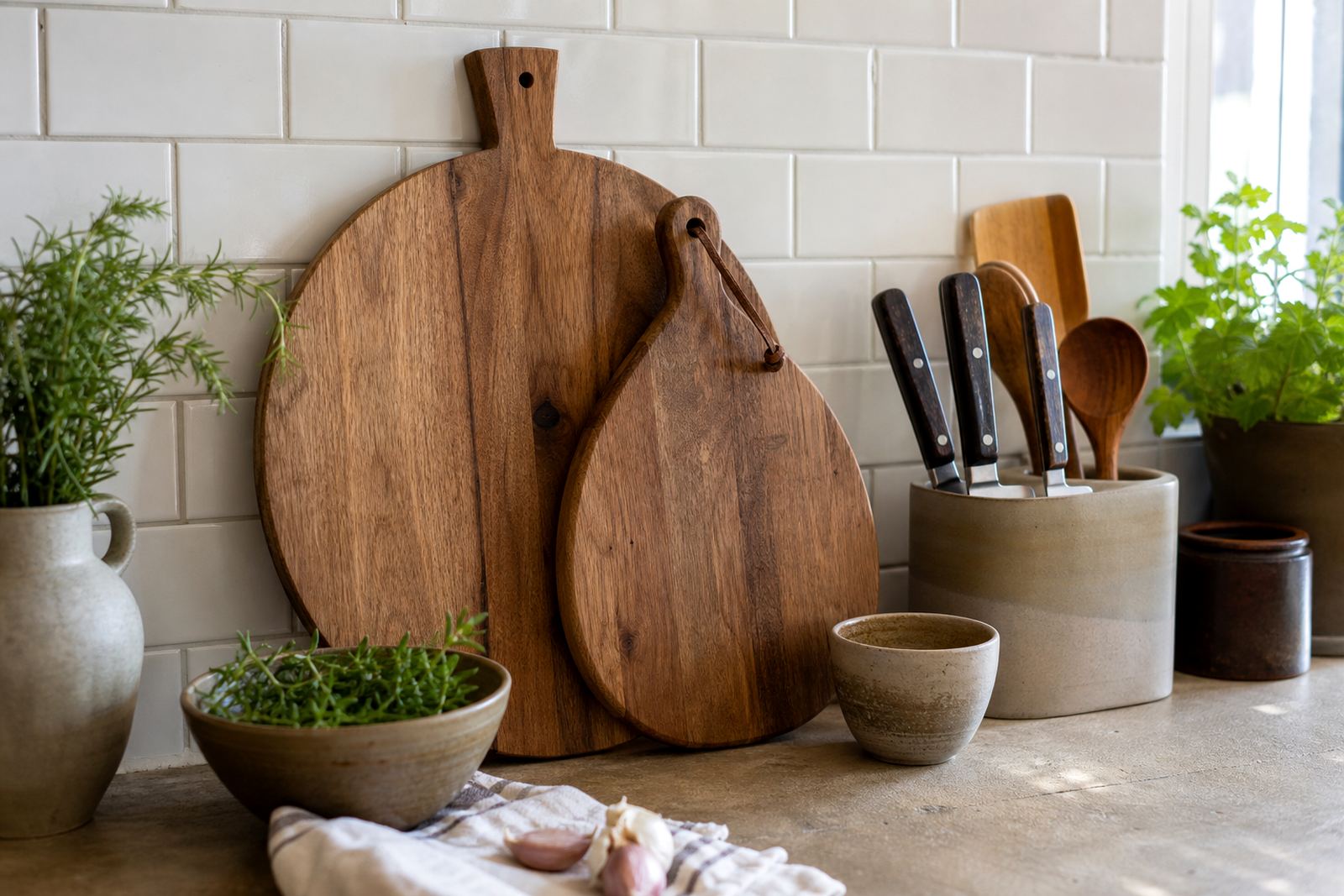
Our chopping boards are made by South African makers using hardwoods selected for density, grain and day-to-day wear. They are suited to the kind of kitchen work that needs a steady board under a knife, while still looking tidy enough to leave out near the hob or on a shelf. The timber used is generally kiln dried and finished to a food-safe standard, with each board showing natural colour variation, knots or grain movement that make every piece different.
These boards work well for fruit, bread, herbs, vegetables and serving cheeses or snacks. In smaller kitchens they also pull their weight as an extra prep surface, while in larger kitchens they sit comfortably as a serving piece beside other handmade wood and ceramic items. Because they are handmade, sizes can vary slightly from piece to piece and a board may measure a few millimetres differently from the stated size.
Sizes and shapes worth asking for
We carry a practical spread of board shapes for different kitchen routines, from compact boards for quick slicing to larger boards for family prep and platter use. Thickness and edge detail vary by maker, and some boards have a handle cut-out, finger groove or rounded corners for easier lifting and storing. If you are matching a board to a shelf, tray or gift box, it helps to confirm the finished measurements before placing an order.
- Small board: about 280 x 180 mm, useful for fruit, cheese or single-person prep
- Medium board: about 350 x 250 mm, suited to daily chopping and serving
- Large board: about 450 x 300 mm, better for loaves, vegetables and shared platters
- Round or oval board: often chosen for serving and open shelf display
- Board thickness: commonly 18 mm to 30 mm depending on the build
Some boards are edge grain, others are face grain, and the feel under the knife is slightly different. Edge grain boards tend to show striped timber lines and can handle regular kitchen use well, while face grain boards often show wider wood character and are especially attractive for serving.
Where these boards sit best in the home
Hardwood chopping boards suit kitchens with open shelving, butcher blocks, stone counters or painted cupboards where natural timber adds contrast. In a Cape Town apartment, a medium board can sit against a splashback without taking much space, while in a Stellenbosch family kitchen a larger board often stays within reach near the sink and prep zone. They also work nicely in guest houses, short-stay kitchens and shared homes where sturdy kitchenware gets used often.
For gifting, boards are popular for housewarmings, weddings and corporate hampers because they are useful, neutral and easy to pair with linen napkins, ceramic bowls or wooden spoons. A board also fits well into a braai setting for bread, biltong or vegetables once the cooking is done.
- Open shelves and hanging rails
- Everyday prep stations and island counters
- Serving areas for shared meals and platters
- Gift boxes for housewarming, wedding and corporate sets
What to confirm before placing an order
Because these are handmade items, it is worth checking the timber type, finish and the exact dimensions needed for your space or gifting plan. Some boards are made from a single timber species, while others use a mixed hardwood build for a distinctive grain pattern. If you are ordering in quantity for corporate gifting or bulk packs, consistency in size and finish should be confirmed first so each piece lands well in the final set.
- Exact length, width and thickness
- Shape: rectangular, round, oval or paddle style
- Timber type and grain pattern
- Finish: oil, wax or another food-safe treatment
- Handle cut-out, juice groove or plain edge
- Quantity for gifting, registry or bulk orders
If a board is intended for serving rather than daily chopping, let us know. That helps with selecting a finish and shape that looks right on a table and stores neatly when not in use.
Care that keeps the timber looking good
Wooden boards last longer when treated with the kind of care that suits timber. Wash by hand with mild soap and warm water, then dry straight away. Do not leave a board soaking in a sink or dishwasher, because standing water can cause warping or splitting over time. If the board feels dry, a light coat of food-safe oil can help keep the surface nourished and reduce surface dullness.
In coastal homes such as Durban or the Atlantic Seaboard, humidity can affect timber movement, so boards should be stored flat in a dry place and not leaned against a damp wall for long periods. For boards used often, occasional sanding and re-oiling can restore the finish and keep the grain smooth under the hand.
- Hand wash only, then dry with a clean cloth
- Keep it away from damp and direct heat
- Oil the board when the surface starts to look dry
- Store flat or upright in a dry spot
- Use separate boards for raw meat and ready-to-eat foods where possible
Delivery, gifting and practical support
LocalMaker sends handmade homeware across South Africa, with delivery to Cape Town, Johannesburg, Durban, Pretoria and Stellenbosch, plus surrounding delivery areas listed on the site. If you are arranging a gift, we can help with wrapping, gift notes, curated gift boxes, registry support, custom bundles and delivery coordination. Corporate orders can also be arranged for teams, clients or event packs, with care taken over presentation and quantities.
If you need a replacement for a damaged item or advice on board care, the team can assist through the enquiry form on the contact page. We keep the process practical, with the aim of matching the right board to the kitchen, the shelf or the gift box it is meant for.
Key facts
| Product type | Handmade hardwood chopping boards |
|---|---|
| Materials | Hardwood timber with food-safe finish |
| Sizes | Approx. 280 x 180 mm, 350 x 250 mm, 450 x 300 mm |
| Thickness | Usually 18 mm to 30 mm |
| Finish options | Oil, wax or similar food-safe finish |
| Use | Chopping, prep and serving |